
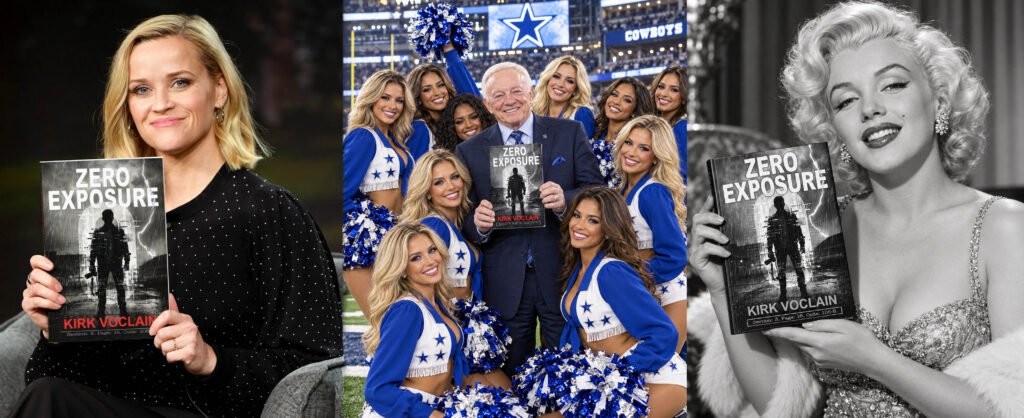
Every author dreams of getting “the email.”
You know the one.
A major book club has discovered your novel. A celebrity loves it. A producer wants to discuss it. A media company believes your book could be the next big thing.
For an indie author, that message can make your heart jump.
Then your brain needs to catch up.
My experience began with an email about my thriller Zero Exposure. The sender claimed to represent Reese’s Book Club and Hello Sunshine. Eventually, the person behind the account went further and claimed to be Reese Witherspoon.
Then came an image that appeared to show her holding my book.
That first fake inspired me to start saving other fabricated promotional images people sent me. Before long, Reese had been joined by an image appearing to show Jerry Jones surrounded by Dallas Cowboys Cheerleaders—and, somehow, Marilyn Monroe.
Apparently, Zero Exposure had not merely attracted celebrity attention. It had learned how to travel through time.
An important clarification: I am not claiming that Reese Witherspoon, Jerry Jones, the Dallas Cowboys Cheerleaders, Marilyn Monroe’s estate, Reese’s Book Club, Hello Sunshine, or any other legitimate person or organization created, approved, or sent these images. The pictures are shown as examples of images sent to me or collected from suspicious promotional outreach. No endorsement by anyone depicted is claimed or implied.
[Place 3Fakes.jpg here]
Three fakes, one book: fabricated images purporting to show famous people promoting Zero Exposure. A polished image is not proof of an endorsement.
The First Email Was Flattering—Which Was the Point
The original message came from:
hello.hellosunshinemedia@gmail.com
It sounded impressive. The sender referenced Zero Exposure, mentioned ideas from the story, and wrote:
“I was immediately drawn to Zero Exposure because it raises a thrilling question: What happens when the fictional world an author creates begins to fight its way into reality?”
That is a good line. I’ll give them that.
The message continued by claiming to come from Reese Witherspoon and suggested that the novel could inspire conversations about suspense, espionage, technology, artificial intelligence, creativity, and storytelling.
As an author, you want to believe something like that.
Someone famous loves your book? Someone with enormous influence sees potential in your story? A major book club wants to introduce it to readers?
That is author catnip.
But polished praise is not proof. Anyone can pull details from a book description, website, review, interview, or social media post. With modern writing and image-generation tools, a stranger can create a convincing pitch—and a convincing-looking photograph—without ever opening the book.
My First Test: Did You Actually Read It?
I have developed a simple rule for people who approach me about promoting my books:
Tell me something that proves you understand the book.
So I asked whether the sender had read Zero Exposure.
The reply was:
“Yes, I spent time reviewing Zero Exposure and the material surrounding it before reaching out.”
Notice the wording.
They did not say, “Yes, I read the book.”
They said they had spent time “reviewing” the book and “the material surrounding it.”
That phrase leaves plenty of room for someone to have read the Amazon description, a few reviews, and some promotional copy before building a convincing response.
The sender also mentioned the 1955 manual typewriter featured in the story. That detail matters—but it can also be found in material available online.
A scammer does not need to read your book. The scammer only needs to know enough to sound as though they did.
Then Came the $255 Fee
After the praise came the price:
“Participation in the reader programming I mentioned involves a one-time participation fee of $255.”
There it was.
The hook was recognition. The bait was credibility. The ask was $255.
That amount is not outrageous by book-marketing standards, and that is precisely why it can work. It is small enough for an author to think, “If this is real, it could be worth the risk.”
Effective scams do not always begin with a demand for thousands of dollars. Sometimes they begin with an amount that feels plausible—and with a dream that feels too important to miss.
The Reviews Made the Offer Even More Troubling
The sender also offered to support Zero Exposure with reviews on Goodreads, BookBub, and Amazon.
Later, I received messages claiming that several Goodreads reviews had been posted. Links were provided as evidence of progress.
The implied message was difficult to miss:
Look what we have already done for you. Now it is your turn to pay.
Reviews should be voluntary, independent, and based on a genuine reading experience. They should not become bargaining chips in a paid promotional negotiation.
Whenever paid marketing, promised reviews, famous names, and pressure to send money begin appearing in the same conversation, stop. Do not allow excitement—or a feeling of obligation—to make the decision for you.
The Marketing Plan Was Mostly Fog
When I asked what the $255 actually purchased, I received phrases such as:
- Reader outreach
- Curation
- Discussion programming
- Community engagement
- Ongoing management
That language sounds professional until you ask basic business questions.
Where will the promotion appear? How large is the audience? What exactly will be delivered? How will results be measured? What reports will the author receive? Who manages the campaign? What is the legal business name? Where is the company located? Why is the offer coming from a Gmail account?
A legitimate marketer may not be able to guarantee sales, but that marketer should be able to explain the service.
If no one can explain the machine, there may not be a machine.
The “Guarantee” Changed When I Pushed Back
At first, the sender correctly said that sales could not be guaranteed.
Later, after I continued asking questions, the offer changed:
“I am prepared to guarantee a minimum of 25–60 attributable book sales during the 12-month program period.”
First, sales could not be guaranteed. Then a specific range was guaranteed.
That kind of shifting promise is a major warning sign. A real service has defined terms. A questionable pitch keeps changing shape to answer the latest objection.
The goal is no longer to explain a product. The goal is to keep the author talking long enough to obtain payment.
From One Fake Image to Three
Eventually, the suspicious marketing claims were accompanied by visual “proof.”
The first image appeared to show Reese Witherspoon holding Zero Exposure. At a glance, an excited author might see a celebrity, a recognizable book cover, and what looks like an endorsement.
Look longer.
The book is enormous. The proportions feel wrong. My thriller looks less like a paperback and more like something printed for a courtroom exhibit.
Nice try, robot. The book is not supposed to be the size of a dorm-room refrigerator.
Once I received that image, I began saving similar examples.
The next picture appeared to place Zero Exposure in the hands of Jerry Jones, surrounded by Dallas Cowboys Cheerleaders inside a stadium. It is an almost comically concentrated fantasy of instant recognition: a famous executive, an iconic football brand, a glamorous crowd, and my book positioned at the center.
Then came Marilyn Monroe holding Zero Exposure.
That image removes any remaining mystery. The book did not exist during Marilyn Monroe’s lifetime. Unless my promotional campaign includes a working time machine, the photograph cannot be authentic.
The three images make an important point: fabricated endorsements do not always arrive as crude graphics. They may be polished, flattering, funny, or nearly believable. They may use recognizable faces and familiar settings to borrow credibility that the sender has not earned.
Whether an image was made through generative AI, photo compositing, or some combination of techniques is secondary. The important question is whether it can be independently verified.
An image is a claim. It is not proof.
How Book Promotion Scams Target Authors
The pattern behind many book promotion scams targeting authors is remarkably consistent:
- Begin with praise. Make the author feel seen.
- Borrow authority. Use the name of a celebrity, book club, publisher, producer, or media company.
- Mention specific details. Pull information from descriptions, reviews, websites, or social media.
- Introduce a manageable fee. Ask for an amount that feels worth the gamble.
- Describe the service vaguely. Use impressive language without measurable deliverables.
- Create apparent proof. Send reviews, screenshots, links, or fabricated celebrity images.
- Encourage obligation or urgency. Make the author feel that work has already begun or that an opportunity may disappear.
Not every unsolicited offer follows this exact sequence. Not every Gmail address, tracking pixel, awkward sentence, or unusual image proves fraud by itself.
The pattern is what matters.
Red Flags Authors Should Watch For
Be especially careful when you encounter:
- A famous person or major company conducting business through an unverified personal email address
- Flattery containing details easily collected from public sources
- A participation fee introduced only after excitement has been created
- Vague promises involving “visibility,” “engagement,” “community,” or “programming”
- Paid promotion and reader reviews blended into the same offer
- Deliverables that change whenever you ask a difficult question
- Sales guarantees that appear only after you hesitate
- Screenshots or celebrity images offered as proof
- Pressure to pay before you can verify the sender independently
One odd detail may have an innocent explanation. A stack of odd details deserves your full attention.
Before Paying Anyone to Promote Your Book
Ask these questions:
- What is your official website?
- What business email domain do you use?
- Can I verify this offer through your company’s public contact information?
- What exactly am I purchasing?
- Where will my book appear?
- What is the size and source of the audience?
- What dates and deliverables are included?
- What reporting will I receive?
- Can you provide examples of previous campaigns?
- Are reviews involved in any way?
- Can you provide a formal invoice, legal business name, and written agreement?
- What happens if the promised work is not delivered?
Most importantly, verify the sender outside the original conversation.
Do not rely on a phone number, link, or contact person supplied by the same account you are investigating. Find the organization’s official website yourself. Use its public contact form. Check verified accounts. Contact the company through a separately confirmed channel.
If a celebrity supposedly endorsed your book, look for independent evidence. Examine the hands, text, lighting, shadows, proportions, and background—but do not stop there. Even a visually perfect image can be fabricated.
Verification must come from the person or organization whose identity is being used.
Why I Am Sharing This
Authors are attractive targets because we are hopeful.
We work for months or years on our books. We want readers, reviews, attention, and that one break that moves a novel from merely available to genuinely discovered.
Scammers understand that dream.
They know authors already spend money on editing, covers, advertising, newsletters, contests, book fairs, review services, and promotional campaigns. A marketing expense does not automatically feel suspicious.
So the scam is packaged inside the dream.
In my case, the package included a famous name, a Gmail address, carefully worded praise, questionable reviews, vague promotional promises, a $255 fee, changing sales claims, and an image in which my book appeared large enough to require its own building permit.
The collection now contains three fabricated celebrity images—and I doubt they will be the last.
If you receive an offer like this, do not panic. Do not argue. And do not celebrate too quickly.
Save the messages. Take screenshots. Verify every identity. Ask specific questions. Do not send money until you know exactly whom you are paying and exactly what you will receive.
Final Thought
I write thrillers, so I appreciate a good plot twist.
But this one was not good enough.
The story relied on borrowed identities, vague promises, questionable reviews, a $255 fee, and fabricated images ranging from physically suspicious to historically impossible.
Authors, be careful out there.
Not every opportunity is an opportunity.
Sometimes it is simply a scam wearing a famous name tag.
My Author Site on Amazon: https://amazon.com/author/kirkvoclain
My Author Site: https://kirkvoclain.com