
Every artificial intelligence system starts in roughly the same place.
It does not understand your question. And it does not know which answer is correct. It cannot separate a useful response from a confident-sounding mistake.
At first, it simply guesses.
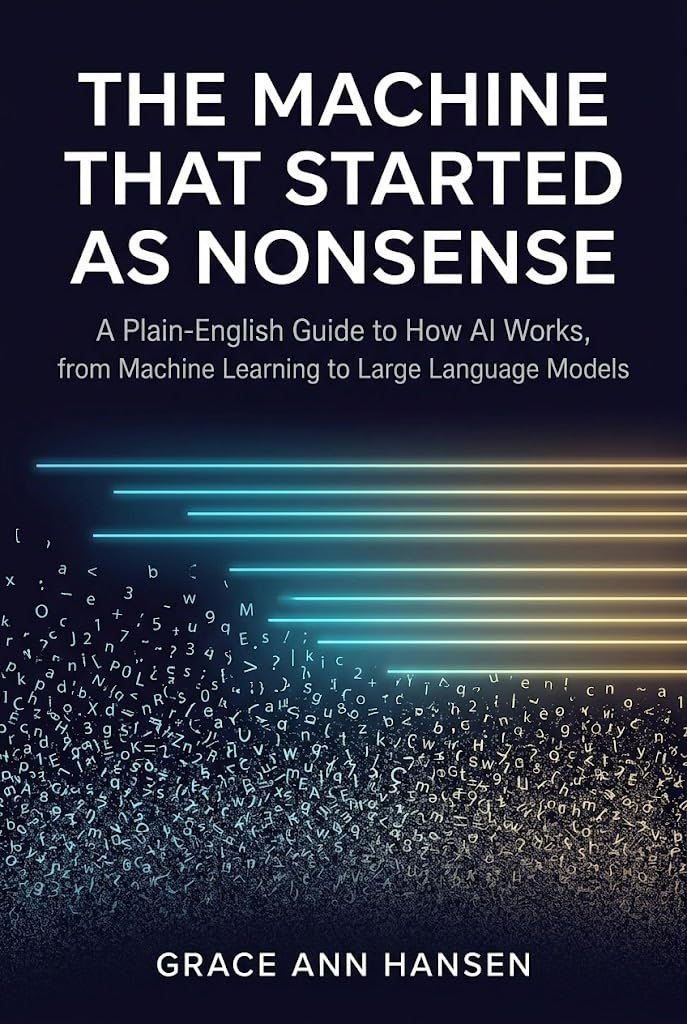
In The Machine That Started As Nonsense: A Plain-English Guide to How AI Works, from Machine Learning to Large Language Models, Grace Ann Hansen explains how developers turn those early guesses into AI tools that write emails, answer questions, analyze information, and generate headlines around the world.
Readers will not find a programming manual or a textbook filled with equations here. Hansen writes for curious people who want to understand what happens behind the screen without first earning a computer science degree.
How Does Training Change an AI?
People often describe AI as if it suddenly wakes up knowing how to speak, reason, and solve problems.
The reality feels much less magical—and far more interesting.
A large language model starts without any understanding of words, facts, or conversation. During training, it processes enormous amounts of information and learns to recognize patterns. With each stage of training, it improves its ability to predict what should come next.
That basic process can eventually produce surprisingly sophisticated results.
Hansen guides readers through the major stages of building and refining a large language model. She explains how developers gather and prepare information, how the model learns from that material, and how additional training shapes the answers people eventually receive.
The machinery may look complicated, but readers can understand the central ideas without mastering every technical detail.
Confidence Is Not the Same as Competence
Anyone who uses AI needs to understand one important lesson: confidence does not guarantee accuracy.
A chatbot can deliver a smooth, polished answer that sounds completely certain. That confident tone does not make the answer correct.
Large language models generate responses by predicting likely patterns. They do not automatically possess human judgment, lived experience, or a built-in ability to verify every statement.
That distinction matters.
Natural conversation can tempt people to assume that an AI understands more than it does. Fluent language and genuine understanding do not always mean the same thing.
Hansen explores this gap without treating readers as technical experts or gullible beginners. Her approach helps readers view AI as neither magic nor meaningless machinery. Instead, they can recognize it as a powerful technology with clear strengths and limitations.
More Than Chatbots and Generated Emails
Many people picture a chatbot when they hear the term artificial intelligence. They may use one to answer questions, create images, or help write a difficult email.
Those applications represent only one part of the field.
Researchers apply similar machine-learning principles to weather data, medical research, scientific discovery, and the development of new materials. Scientists can adapt the same broad concepts that help a system predict the next word to solve very different kinds of problems.
That reach helps explain why artificial intelligence now influences conversations about work, education, healthcare, creativity, business, and public policy.
Programmers no longer have sole ownership of this subject. Anyone who wants to understand the modern world can benefit from learning how AI works.
Looking Beyond the AI Headlines
News coverage about artificial intelligence often swings between two extremes.
One headline promises that AI will solve nearly every human problem. The next warns that it will replace everyone by Tuesday.
Neither extreme leaves much room for understanding.
The Machine That Started As Nonsense encourages readers to slow down and ask better questions.
What task did the developers train the system to perform? Which information shaped its responses? What evidence supports the results? Who benefits from the claim? What important details might the headline leave out?
The final chapter gives readers six questions they can apply to AI claims they encounter online, at work, or in the news.
That framework may provide the book’s most practical contribution. Technology will continue to change, but thoughtful questions will never lose their value.
The Hidden Cost of Training AI
When companies say they use publicly available data to train an AI, the process can sound almost effortless.
It is not.
Development teams invest enormous amounts of data, computing power, energy, time, and human labor into modern AI systems. Every model also depends on decisions about which information to include, how to organize it, and which responses to reward.
Those choices raise questions about ownership, labor, accuracy, energy use, and consent.
Hansen brings these concerns into the larger story of how people create AI. She asks readers to look beyond the finished product and consider the people, information, and resources that made it possible.
A clear view of AI requires more than knowing what a tool can do. Readers should also ask what it took to create that tool and who carried the cost.
Who Should Read The Machine That Started As Nonsense?
This book may appeal to readers who:
- Use AI but do not fully understand how it works
- Feel overwhelmed by technical explanations of machine learning
- Want to evaluate AI headlines more critically
- Feel curious about large language models and chatbots
- Work in education, writing, healthcare, business, or technology
- Prefer explanations without code or calculus
Across 295 pages, Hansen builds a substantial introduction while keeping the ideas clear and accessible.
She writes for curious adults who want an honest explanation—not a sales pitch, a panic button, or a wall of mathematical formulas.
Understand the Machine Before Believing the Hype
Artificial intelligence will play an increasingly visible role in everyday life.
Some of its accomplishments will prove genuinely remarkable. Marketing campaigns will inflate other claims. Polished language and confident promises may obscure important failures.
Readers need the ability to tell the difference.
The Machine That Started As Nonsense by Grace Ann Hansen offers a plain-English path from random guesses to modern AI. It also equips readers with the questions they need to keep asking once they understand the basics.
Get the Book
Learn more about The Machine That Started As Nonsense: A Plain-English Guide to How AI Works, from Machine Learning to Large Language Models by Grace Ann Hansen: